
非政府組織發言稿|兩公約第四次國家報告國際審查
民間團體聯合聲明
2026-5-11
2026-5-11
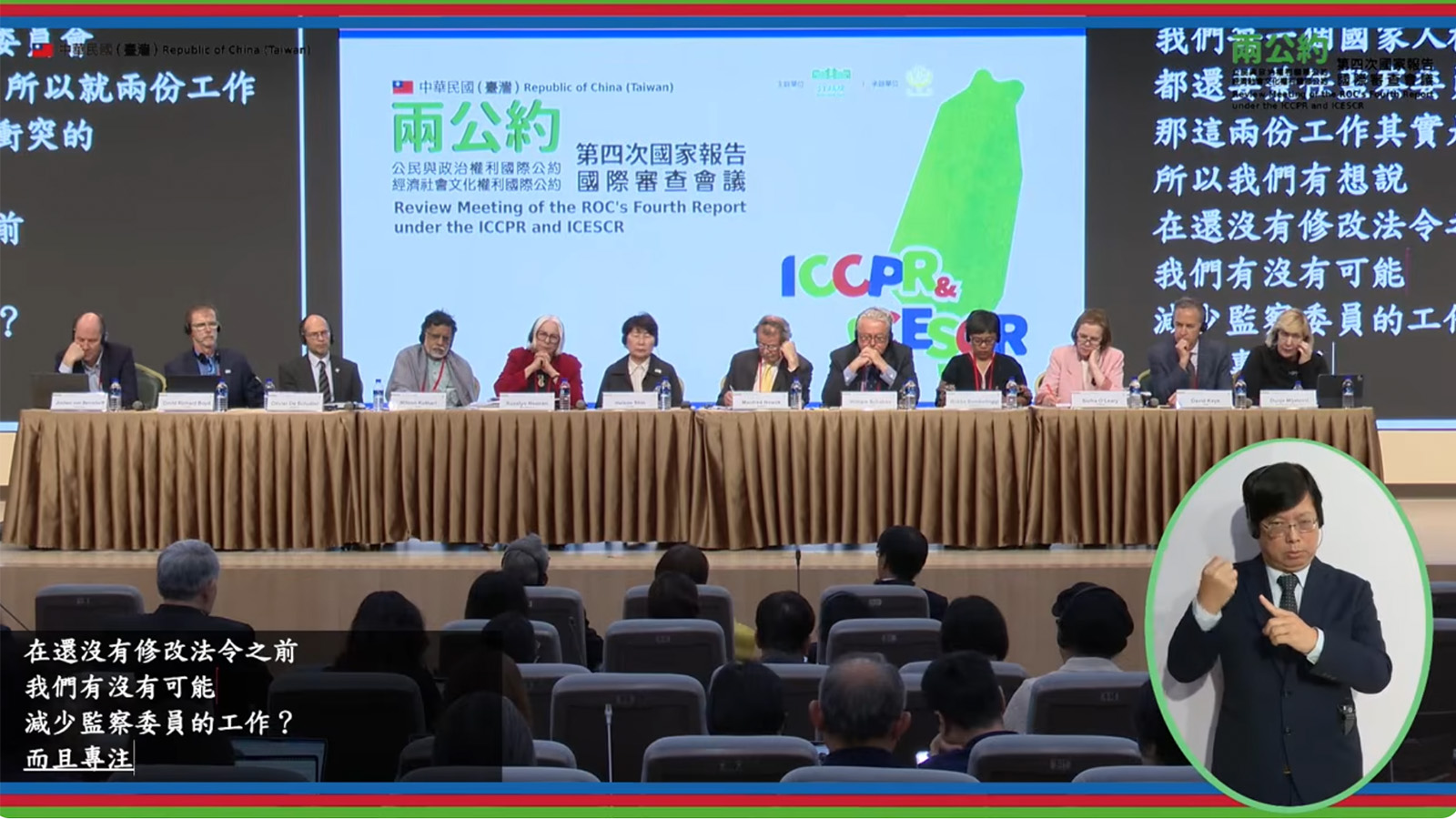
各位審查委員、各位政府機關代表、NGO伙伴,
首先,我們肯定政府定期辦理公約審查。從2013年兩公約首次審查以來,結論性意見是促進臺灣立法和政策改變,落實人權的重要推手。我藉此感謝國際專家為臺灣的人權付出努力。
臺灣的憲法法庭共15位大法官,自從2024年12月七位大法官退休以來,立法院否決了所有的被提名人;立法院又以《憲法訴訟法》要求至少10名出席,使得憲法法庭停擺超過一年,許多重要案件懸而未決。雖然五名大法官的裁定使憲法法庭暫時脫困,但立法院的結構性問題仍未解決。同樣的,由於在野黨的杯葛,國家人權委員會目前委員七月底任期屆滿後,恐怕難有第二屆委員。最核心的人權保障機制正在被破壞。
在政治局勢這麼紛亂的情況下,掌握著行政權的執政黨,當然要大張旗鼓的維護臺灣民主、法治和人權的核心價值。然而,情況並非如此:
第一,執政兩年,政府尚未提出第二期國家人權行動計畫,欠缺作為。禁止酷刑公約,國家酷刑預防機制、綜合性反歧視法、難民法等等,都沒有進展。
第二,政府在與在野黨的攻防戰中,例如「終身監禁不得假釋」這種明顯的人權議題上,沒有守住人權底線。
第三,欠缺對人權的完整論述和願景。人權不只用來保護少數人;也包括保障每個人生活的經濟和社會權利。人民對社會服務有很高的需求,但政府總期待以最低的資源來滿足這些需求,使得第一線工作人員,無論是護理師、社工師、監獄管理員、甚至法院和地檢署的書記官,都面臨人力短缺和資源不足的困境。期待政府提出完整的人權架構,並再次確認「人權立國」的基本國策。
其次,我要提醒人權倒退的修法趨勢。
113憲判8發布後,法務部執行一例死刑,總統賴表示,根據憲法法庭判決,死刑合憲,希望社會大眾支持法務部依法執行死刑。法務部接著修正《執行死刑規則》,讓死刑執行標準更寬鬆。我們提醒政府,113憲判8只針對幾個特殊犯罪類型,強調在嚴密的法律程序下判死刑是可以接受的,並沒有針對「死刑」本身進行裁判。政府除了應該修法讓司法程序更為嚴謹之外,應該依據公約,繼續推動廢除死刑的政策。但政府反而擴大死刑的適用,將兒虐致死案件納入死刑適用範圍,與公約義務背道而馳。
不只死刑,立法院在野黨提出終身監禁、鞭刑等民粹草案,法務部甚至提出比在野黨更嚴格的「終身監禁不得假釋」草案,剝奪受刑人復歸社會的可能。
國家很少探討犯法行為背後的社會因素,尋求降低犯罪風險的可能性,也很少對處在高犯罪風險環境的兒童和青少年進行輔導,例如高風險家庭的即時協助與早期介入,資源嚴重不足。政府反而執著於嚴刑峻罰,即將推出更嚴苛的少年司法修法。這是無效的政策,不但違背人權,也違反了社會科學證據。
此外,面對地緣政治與戰爭風險,國防部擬推軍事審判法草案,恢復平時軍事審判。然而草案欠缺充分的社會溝通,且擬將軍事法院置於國防部而非司法院管轄,對司法獨立保障有重大疑慮。
面對中國威脅與國際新秩序壓力,人權被視為絆腳石,而非立國根基。懇請專家提醒台灣政府:唯有堅守人權理想,台灣才能呈現其獨特的精神和價值,成為值得人民為之奮鬥的國家。
Distinguished Committee Members,
Government representatives, NGO representatives,
First, we would like to acknowledge the government’s regular implementation of treaty reviews. Since the first review of the two Covenants in 2013, the Concluding Observations have served as an important driving force for legislative and policy changes in Taiwan, and for the realization of human rights. We would like to take this opportunity to thank the international experts for their efforts and contributions to human rights in Taiwan.
Taiwan’s Constitutional Court is composed of 15 Justices. Since the retirement of seven Justices in December 2024, the Legislative Yuan has rejected all nominees. At the same time, amendments to the Constitutional Court Procedure Act require a minimum of 10 Justices to be present, resulting in the Constitutional Court being paralyzed for over one year, with many important cases left unresolved. Although a ruling by five Justices has temporarily allowed the Court to resume operation, the structural problem in the Legislative Yuan remains unresolved. Similarly, due to obstruction by opposition parties, the current members of the National Human Rights Commission will see their terms expire at the end of July, and it is likely that a second term of Commissioners cannot be appointed.
The most fundamental human rights protection mechanisms are being undermined.
Under such a turbulent political situation, the ruling party, which holds executive power, should actively and visibly safeguard the core values of democracy, rule of law, and human rights in Taiwan. However, this has not been the case.
First, after two years in office, the government has not yet proposed a second National Human Rights Action Plan, reflecting a lack of action. The Convention against Torture, the National Preventive Mechanism, a comprehensive anti-discrimination law, and refugee legislation have all been delayed for years without progress.
Second, in its political confrontation with the opposition, the government has failed to uphold the bottom line of human rights. For example, on clearly human-rights-related issues such as “life imprisonment without parole,” the government has not taken a firm stance.
Third, there is a lack of a comprehensive narrative and vision for human rights. Human rights are not only about protecting minorities; they also include the protection of economic and social rights for everyone. There is a high demand among the public for social services, yet the government consistently responds with minimal resource allocation. As a result, frontline workers—including nurses, social workers, prison officers, and clerks in courts and prosecutors’ offices—are facing serious shortages of personnel and resources.
Therefore, we expect the government to present a comprehensive human rights framework and to reaffirm the fundamental national policy of building a state based on human rights.
Second, several important human rights bills have stalled, and there are even regressive legislative trends.
After Constitutional Judgment No. 113-Hsien-Pan-8 was issued, the Ministry of Justice carried out one execution. President Lai stated that, according to the Constitutional Court’s judgment, the death penalty is constitutional, and he called on the public to support the Ministry of Justice in carrying out executions in accordance with the law. Subsequently, the Ministry of Justice amended the Rules for the Execution of the Death Penalty, making the standards for execution more lenient.
We would like to remind the government that Constitutional Judgment No. 113-Hsien-Pan-8 addressed only several specific categories of crimes, and emphasized that the death penalty may be acceptable only under strict procedural safeguards. It did not make a judgment on the death penalty as such. In addition to strengthening procedural safeguards through legislative amendments, the government still bears obligations under international human rights treaties to continue moving toward abolition of the death penalty. However, instead, the government has expanded the scope of application of the death penalty—for example, by including fatal child abuse cases—moving in the opposite direction of its treaty obligations.
Not only on the death penalty, but more broadly, opposition parties in the Legislative Yuan have proposed populist bills such as life imprisonment and corporal punishment. More concerningly, the Ministry of Justice has proposed an even stricter version of “life imprisonment without parole,” depriving detainees of any possibility of reintegration into society.
At the same time, we observe that the state rarely examines the social factors underlying criminal behavior or seeks ways to reduce crime risks. There is also insufficient support for children and youth in high-risk environments, such as timely assistance for high-risk families and early intervention measures, where resources are severely lacking.
The government remains focused on imposing harsher punishments on offenders, and is about to introduce more severe juvenile justice reforms. This is an ineffective policy. It not only violates human rights, but also contradicts social science evidence.
In addition, in response to geopolitical tensions and risks of war, the Ministry of National Defense is proposing a draft Military Trial Act to restore military trials during peacetime. However, the proposal lacks sufficient public consultation, and the plan to place military courts under the Ministry of National Defense, rather than under the Judicial Yuan, raises serious concerns regarding judicial independence.
Finally, in the face of threats from China and pressures from the evolving international order, human rights are increasingly being treated as an obstacle rather than as the foundation of the state.
We respectfully request the Committee to remind the Government of Taiwan that only by upholding the ideals of human rights can Taiwan demonstrate its unique spirit and values, and become a country that its people are willing to stand up for.