
Remarks by Lee Ming-Ju on the 36th Anniversary of the 1989 Tiananmen Square Crackdown and the 10th Anniversary of the 709 Crackdown
Lee Ming-Ju, Deputy Executive Director of the Judicial Reform Foundation; Photo by Yang Gang
2025-6-04
2025-6-04
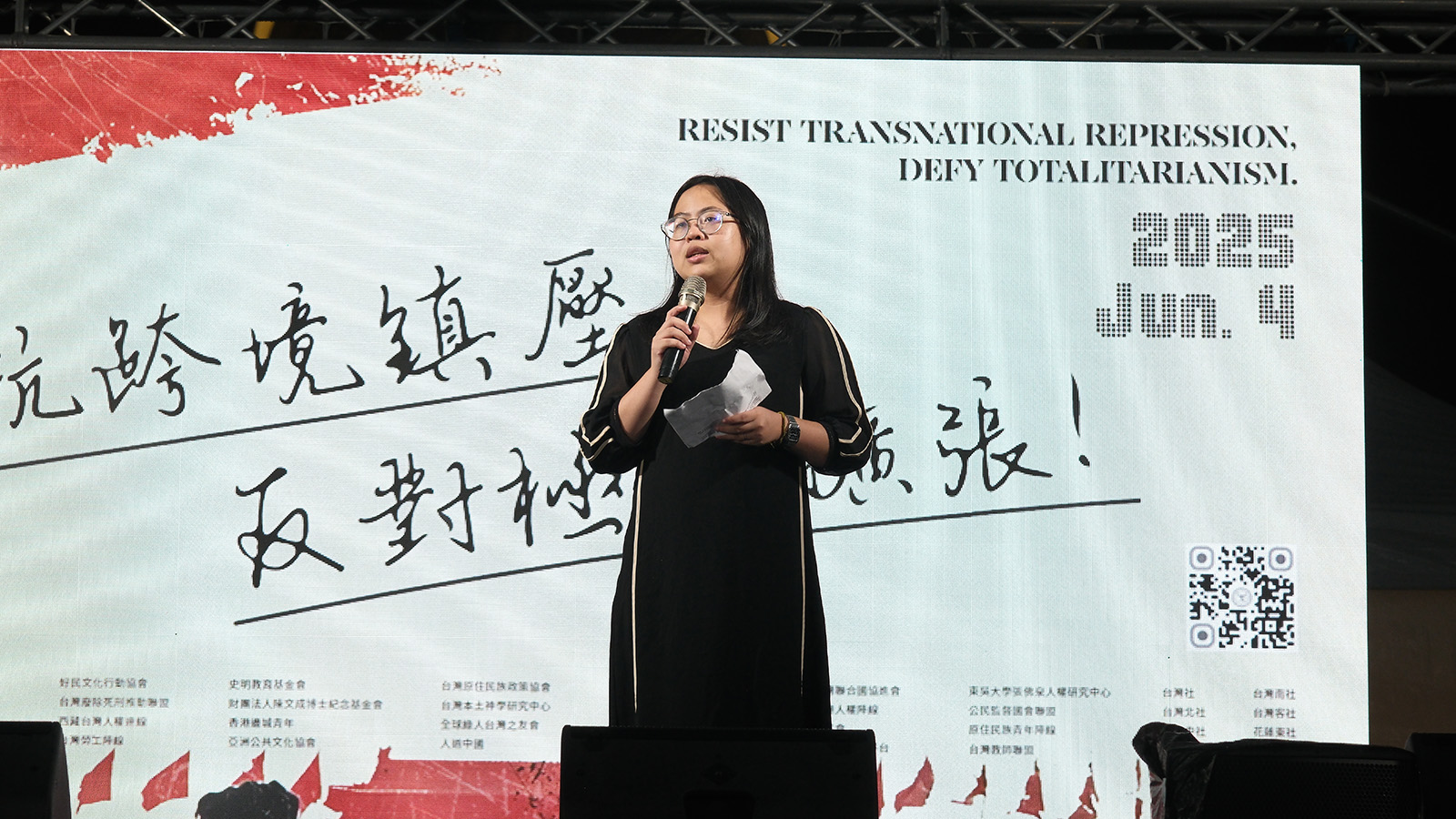
Good afternoon. I am Lee Ming-Ju, Deputy Executive Director of the Judicial Reform Foundation.
This year marks the 36th anniversary of the 1989 Tiananmen Square crackdown in China. Although the Chinese authorities continue to expand its use of force and authoritarian rule in various regions, the spirit of the pursuit of democracy and freedom demonstrated by those who stood in Tiananmen Square in 1989 has never disappeared.
This year also marks the 10th anniversary of the 709 crackdown on human rights lawyers in China.
Ten years ago, in the early hours of July 9, 2015, the large-scale detention of human rights lawyers and activists—later known internationally as the “709 crackdown”—shocked the world. Chinese public security and state security officers suddenly detained lawyer Wang Yu of the Beijing Fengrui Law Firm, along with her husband, lawyer Bao Longjun, and their son Bao Zhuoxuan (also known as Bao Mengmeng).
In total, 316 human rights lawyers, law firm staff members, human rights defenders, and their family members were summoned, subjected to compulsory interrogations, restricted from leaving the country, placed under residential surveillance, criminally detained, forcibly disappeared, or arrested. Among them, 36 individuals were formally detained or subjected to enforced disappearance.
Ten years later, the professional environment for human rights lawyers in China has not improved and, in many cases, has deteriorated further. Observed measures against them include restrictions on personal freedom, revocation or suspension of legal licenses, and travel or exit restrictions. In some cases, even their family members have been subjected to harassment. Beyond routine surveillance and stalking, families have been repeatedly forced to relocate, as local authorities pressure landlords to terminate leases or compel children to transfer schools, effectively forcing them to return to their place of household registration.
In recent years, the Chinese government’s repression of human rights defenders has extended overseas through various forms of transnational repression. In its latest report released in February this year, Freedom House documented 160 incidents of transnational repression worldwide in 2024, identifying the Chinese government as one of the primary perpetrators. Such actions pose serious threats to democracy, human rights, and security globally. In addition to direct actions such as abduction or physical attacks, the Chinese government has used diplomatic and economic pressure to demand the repatriation of exiled individuals. Freedom House noted that China has pursued irregular extraditions or forced returns in multiple countries, with Southeast Asia and Central Asia frequently serving as primary targets.
Nevertheless, both inside and outside China, many Chinese human rights lawyers and defenders continue to stand up courageously, expose the truth, and speak out against government repression, seeking the attention and support of the international community. Such courage is all the more precious in this dark and uncertain era.
Today, as we gather here, I believe that everyone present cares deeply about the state of human rights in China and does not want to give up seeking possible paths forward. I hope we will not forget those who continue to work tirelessly for these causes. The Judicial Reform Foundation will continue to follow developments closely, support the rule of law, and defend democracy. Thank you.