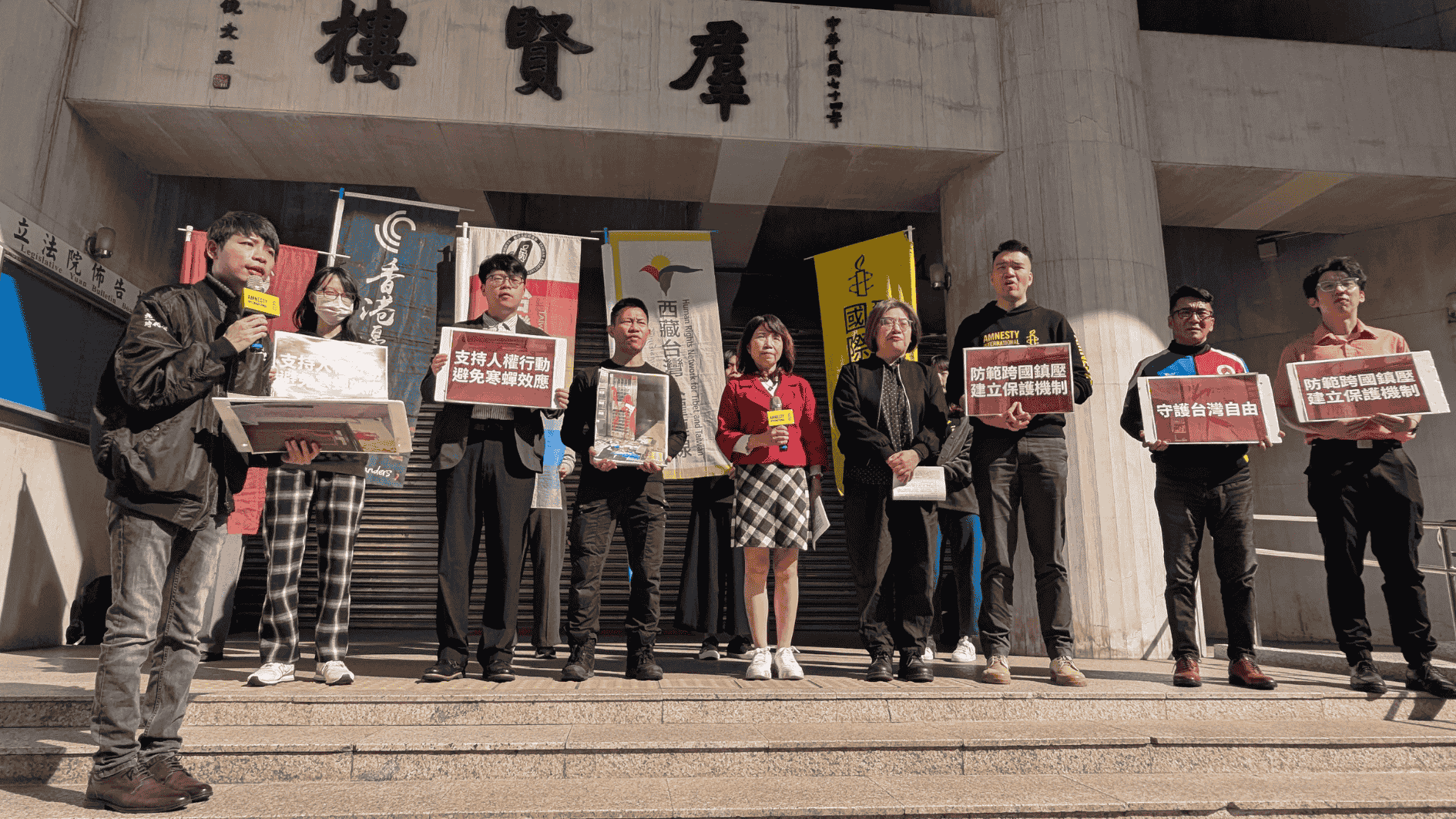
Recently, the Taiwanese government expressed concern over an incident in which red paint was splashed on a Muay Thai studio run by Hong Kong activist Tong Wai-hung (also known as “Fu Tong”), a participant in the Anti-Extradition Law Amendment Bill Movement who now resides in Taiwan. However, civil society groups point out that such intimidating attacks intended to create a chilling effect are rapidly increasing. This trend demonstrates Taiwan’s urgent need to establish a human rights-based and survivor-centred reporting and response mechanism to address forms of transnational repression carried out by foreign governments or their proxies.
Fu Tong: Threats Have Invaded Private Life — Authorities Should Not Punish Only “Disposable” Agents
Fu Tong stated that the attack represents a significant escalation beyond the harassment previously seen at demonstrations:
“In the past, harassment against us occurred only during public activities. Now these threats have blatantly crossed the line and intruded into our private lives. This fear does not only hang over Taiwan — it is spreading globally. Countless Hongkongers living in exile are facing cross-border crimes and intimidation that reach far beyond national boundaries.”
He further stressed that Taiwan must not limit its response to punishing the visible proxies involved.
“If we continue to tolerate this, the damage will extend far beyond the personal safety of individual advocates. It will fundamentally erode the rule-of-law foundation and democratic system that we take pride in.”
Transnational Repression Creates a Chilling Effect and Violates the Rights of Exiled Communities in Taiwan
Everyone should be able to exercise their rights freely without fearing retaliation for criticizing a regime. Although there is currently no unified legal definition in national legal systems, civil society organizations and international human rights bodies generally describe “transnational repression” as actions by governments that silence critics abroad through intimidation, surveillance, threats, abuse of legal processes, or physical attacks.
A 2024 report by Amnesty International titled “On My Campus, I Am Afraid” notes that transnational repression has become one of the primary methods authoritarian governments use to violate the rights of people overseas.
In other words, such practices not only create fear and threats to the personal liberty and safety of exiled Hongkongers, Tibetans, Uyghurs, and other displaced communities. They can also generate a chilling effect within those communities and across society more broadly. Civil society groups, journalists reporting on issues related to the country involved, and individuals concerned with human rights may also be affected, as they may feel unable to fully exercise their rights to freedom of expression or peaceful assembly.
Taipei Muay Thai Studio Vandalized After Arrest Warrant Issued for Fu Tong — Case Highlights Institutional Gaps
In November 2025, Hong Kong’s Independent Commission Against Corruption (ICAC) issued an arrest warrant for Tong Wai-hung (“Fu Tong”), accusing him of violating election regulations after he allegedly called for a boycott of the upcoming Legislative Council election. A few days later, his boxing gym in Taipei was attacked with red paint, and nearby surveillance cameras were reportedly cut off. After Fu Tong reported the case to the Taipei police, authorities identified two suspects holding Hong Kong passports who left Taiwan immediately after the incident. According to reports, two Taiwanese suspects have also since been identified. The case has entered judicial proceedings and remains under investigation.
According to the latest reports, on February 4, 2026— the day before a civil society press conference — Fu Tong’s Muay Thai studio was again splashed with paint. Such acts not only threaten personal safety but also produce a serious chilling effect on communities in Taiwan and may deter others from freely expressing their views or participating in civic action.
Taiwan Lacks Institutional Mechanisms to Address Transnational Repression — Civil Society Groups Raise Four Key Demands
Currently, Taiwan lacks dedicated legal measures addressing transnational repression, as well as mechanisms for victim reporting, risk mitigation, and corresponding protection and support systems.
The Fu Tong case serves as a reminder that the Taiwanese government must establish a systematic legal framework and supporting policies. Taiwan should ensure that the issue of transnational repression is examined not solely through a national security lens, but also from a human rights perspective, in order to effectively protect potential victims from such repression.
Participating organizations at the press conference jointly called on the government to:
- Establish a reporting and tracking mechanism for transnational repression and regularly publish statistical reports on such cases.
- Strengthen inter-agency coordination and establish relief channels as well as protection and support measures centred on human rights protections.
- Publicly condemn human rights violations caused by transnational repression.
- Enhance awareness within government agencies and civil society of transnational repression as a form of human rights violation.
Given the increasing prevalence of transnational repression, the government should adopt necessary measures, including legal and policy frameworks, to safeguard the rights of everyone in Taiwan—particularly those rights most severely affected, such as freedom of expression, freedom of association, and the right of peaceful assembly. Individuals should not fear retaliation for speaking out. At the same time, perpetrators and collaborators must be held accountable and subject to legal sanctions.
Full Statement by Lawyer Chen Yen-keng
Deputy Convener, International Committee, Judicial Reform Foundation
Regarding the “Fu Tong incident,” the Judicial Reform Foundation offers the following two observations:
First, regarding the legal aspects of the case.
As the case remains under investigation, it would be inappropriate and impossible for us to comment in detail on the specific facts. However, based on current media reports and statements by the Mainland Affairs Council, the case has already been characterized as involving transnational repression. It must be noted that “transnational repression” is not currently a formal legal term in Taiwan’s laws. In practice, prosecutors and police must still rely on existing provisions of the Criminal Code, such as offenses relating to unlawful deprivation of liberty or similar crimes. There is currently no special legislation that directly addresses this category of conduct.
This highlights a deeper issue: when facing actions involving foreign regimes or their agents intimidating or interfering with Hongkongers, Tibetans, or other exiled communities in Taiwan, are Taiwan’s existing legal tools sufficient? Are protections adequate? Should Taiwan consider reviewing and amending laws such as the Anti-Infiltration Act and the National Security Act, or studying the possibility of adopting an agent registration law, in order to respond more comprehensively to China’s transnational repression?
The Judicial Reform Foundation believes that relevant government authorities have a responsibility to confront this issue directly and initiate concrete legal studies and legislative discussions.
Second, regarding the perspective from which the government responds to transnational repression.
At present, government agencies such as the Mainland Affairs Council and the Ministry of Foreign Affairs largely approach the issue of transnational repression from the perspective of national security. The Judicial Reform Foundation believes that in addition to this national security perspective, Taiwan must also — and perhaps more fundamentally — evaluate China’s acts of transnational repression and interference in sovereignty through the lens of human rights standards.
In the Fu Tong case, China has long used state institutions or their proxies to plan, direct, and carry out systematic campaigns targeting Hongkongers, Tibetans, and other diaspora or exiled communities in Taiwan. These actions include restricting freedom of expression, shrinking space for social participation, and creating a chilling effect through intimidation and silencing.
One of the most common tactics is instructing individuals to conduct harassment, intelligence gathering, or even direct violations of fundamental rights across borders.
In response to such situations, the Judicial Reform Foundation argues that the government should at least consider the following principles:
- Establish a clear legal definition and comprehensive regulatory framework for transnational repression targeting Hongkongers, Tibetans, and other exiled communities in Taiwan.
- Improve the sensitivity and recognition capacity of all government agencies regarding transnational repression and foreign interference in sovereignty.
- Establish a centralized, cross-ministerial reporting and monitoring mechanism for such cases.
- Pursue legal accountability for responsible states and individuals in accordance with the law.
- Provide necessary and substantive protection and support measures for those subjected to repression.
- Actively cooperate with other democratic countries to prevent China’s transnational repression and human rights violations targeting Hongkongers, Tibetans, and exiled communities in Taiwan.
The Judicial Reform Foundation emphasizes that transnational repression is not only a national security issue, but also a serious human rights violation. Only by placing freedom, democracy, and human rights at its core can Taiwan truly become a safe haven for the oppressed — rather than a place where authoritarian power from China can extend its reach to intimidate others.